Toon Tap Reflex
Reviews
Toon Tap Reflex strips the reaction genre down to its essentials: nine brackets, popping toon characters, and a tap window that shrinks as waves progress. The colorful 3D presentation and lack of inappropriate content make it easy to recommend for casual and family play. Its limitation is repetition, since there are no upgrades or modes beyond score chasing. Players who enjoy beating their own best times will get the most from it.
Description
What You Actually Do
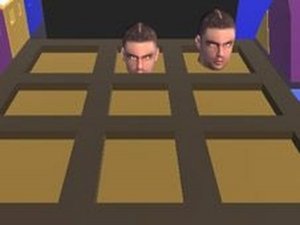
Toon Tap Reflex is a reaction game built around one repeated action: tapping or clicking a toon character the moment it appears from one of nine brackets. Each character stays visible for a short window, and a successful tap adds points to your score. Miss the window and the character retreats without contributing to your total. Because every wave has a time limit, you cannot simply wait for easy targets. The core loop asks you to scan the screen, identify which bracket is active, and commit to a tap before the character disappears. That is the whole skill curve, and it is deceptively demanding once the pace climbs.
How Difficulty Scales
The opening waves move at a gentle pace, which gives new players room to learn the layout of the nine brackets and adjust to the timing. As you complete waves, the characters pop out and retreat faster. This gradual speed increase is the main progression system: there are no unlocks or upgrades to manage, only a steadily shrinking reaction window. The result is a difficulty curve that rewards consistency rather than memorization. You are not learning a fixed pattern so much as training your eyes to react to unpredictable appearances under rising time pressure. The goal is always the highest score you can reach before misses and expired waves catch up with you.
Presentation and Tone
The visual style leans on colorful 3D graphics and a playful toon theme. Characters are designed to read clearly against the background, which matters in a game where split-second recognition decides whether you score or miss. There is no violence or inappropriate content, and the overall tone stays light and humorous. That combination makes the game easy to hand to a younger player or play in short bursts without any heavy setup. The controls are simple one-tap inputs, and the game runs on mobile, tablet, and desktop, so the same session works whether you are on a phone or a larger screen.
Who Gets the Most Out of It
This is a casual score-chasing game rather than a story-driven one. Players who enjoy quick reflex tests and beating their own best numbers will find the most to return to. Sessions can be as short as a few minutes or stretched longer depending on how many waves you survive. The lack of complex systems keeps it accessible, but the rising speed means experienced players still have something to push against. If you prefer slow, thoughtful games, the constant tapping and accelerating pace may feel repetitive; if you like fast, simple challenges, the format is built for exactly that.





Editorial Notes