Match 2 Balls Puzzle
Reviews
Match 2 Balls Puzzle takes the familiar Onet matching rule and applies it to colorful balls. The two-turn path limit is the main source of challenge, and the hint and shuffle buttons provide a safety net without removing the need to think ahead. Because each level uses a new layout and there are no timers, the game suits short breaks or relaxed sessions. The main limitation is that the core loop is narrow: if you do not enjoy matching puzzles, the format offers little else.
Description
The Core Matching Rule
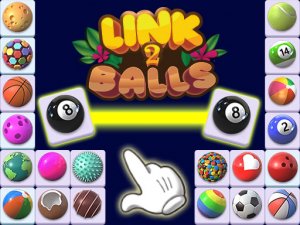
Match 2 Balls Puzzle follows the Onet matching formula: the board is filled with colorful balls, and your goal is to clear it by pairing identical ones. The twist is the connection requirement. Two balls only match if a clear path links them, and that path can bend at most twice at 90-degree angles. A straight line counts as zero turns, one corner is allowed, and two corners are the limit. If any ball blocks the route, the match is rejected. This constraint turns a simple visual scan into a spatial reasoning task, because you are not just looking for twins but for twins that are reachable.
How a Turn Plays Out
Tap one ball to select it, then tap a second ball with the same color. When the path is valid, both disappear and the board opens up. That opening matters: removing a pair can expose new routes that were previously blocked, so the order you clear pairs often determines whether the rest of the board stays solvable. When no valid pair remains, the Hint button reveals a possible match, and the Shuffle button rearranges the balls to create fresh opportunities. Both tools are limited, and you earn extra uses by completing levels, which encourages careful play rather than constant reliance on assistance.
Level Structure and Difficulty
Every level presents a new layout, so the puzzle does not rely on memorizing a single board. Difficulty comes from the arrangement of balls and how tightly packed the paths become. Early boards tend to offer obvious pairs near the edges, while later layouts require you to plan several removals ahead. The game does not use timers or penalties, so the pace stays relaxed. That design suits short breaks as well as longer sessions, and it keeps the focus on observation instead of reflexes.
Who It Suits
The simple tap controls and absence of violence or inappropriate content make this a reasonable choice for family play. Players who enjoy Onet-style puzzles, Mahjong solitaire, or other matching games will recognize the core loop immediately. Anyone looking for a low-pressure game that still asks for planning and attention will find the difficulty curve gentle but not flat.





Editorial Notes