Doggie Duo Memory Match
Reviews
Doggie Duo Memory Match delivers exactly what its name suggests: a straightforward matching game built around dog illustrations. The three difficulty levels adjust grid size, giving beginners a comfortable start and offering more demanding boards for experienced players. Because the deck reshuffles every round, success depends on active recall rather than pattern memorization. The absence of ads, purchases, and external links makes it a practical choice for families. Its main limitation is a lack of variety beyond the core matching loop, but for a casual brain exercise, that focus works in its favor.
Description
Matching Pairs Against the Clock
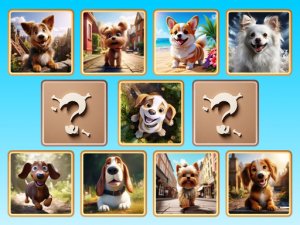
Doggie Duo Memory Match asks you to clear a board of face-down cards by finding every matching pair of dog illustrations. You flip two cards per turn; if the images match, they stay face up. If not, they flip back after a short pause. A timer counts down, so you must balance speed with careful recall. The board is randomly arranged each round, so memorizing positions from a previous game won't help.
Difficulty Settings and Grid Sizes
Before each round, you pick a difficulty level: easy, medium, or hard. Each level changes the grid size, which directly affects how many cards you need to track and how long a full clear takes. Easy grids are small and forgiving, while harder grids demand stronger concentration and a systematic approach. The timer scales with the grid, but the core challenge remains the same: remember what you saw and where you saw it.
Simple Controls, Broad Appeal
Click or tap a card to flip it, then choose a second card. That's the entire control scheme, which makes the game immediately playable on desktop and mobile browsers. There are no ads, no in-app purchases, and no external links, so parents can feel comfortable letting children play. The dog artwork is cheerful and varied, giving each match a small visual reward.
Building Memory Skills
Because the deck reshuffles every round, you can't rely on a fixed layout. Instead, you develop a mental map of card positions as you flip. Starting on easy helps you learn the rhythm of the game before moving to larger grids. Short breaks between rounds can keep your focus sharp, especially on harder difficulties where one missed pair costs valuable time.





Editorial Notes