Memory Cars Puzzle
Reviews
Memory Cars Puzzle does one thing and does it clearly: flip cards, match identical racing cars, and clear boards that grow larger over time. The car theme gives the matching mechanic a visual hook that plain card backs would lack, and the lack of reading or complex controls keeps the barrier to entry low. Its main limitation is depth. There is no described story, timer, or multiplayer mode, so players seeking variety may find it repetitive. It works best as a short, focused concentration exercise for families or casual players.
Description
What You Actually Do
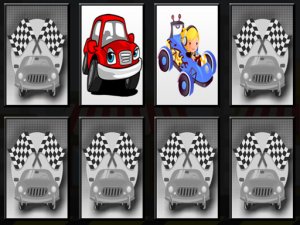
Every round in Memory Cars Puzzle is a straightforward matching task: you flip two cards at a time, and each card shows a racing car. If the two cars are identical, the pair stays face up. If they are not, both cards turn back over after a brief pause. The board is cleared once every pair has been matched. There is no timer pressure described and no reading required, so the entire experience rests on how well you track what you have already seen.
How the Difficulty Grows
The game does not open with a crowded board. Early levels use a small number of cards, which keeps the first few minutes approachable. As you complete each board, later levels add more cards to the layout. That single change is what drives the difficulty curve: more cards means more positions to remember and a higher chance of mixing up similar car images. Because the progression is tied to completion rather than a score threshold, you move forward simply by clearing pairs.
Reading the Board
Since every card hides a car, the main skill is spatial memory. Noticing where a specific color or car shape appeared, even when the flip did not produce a match, is what makes later boards manageable. The colorful car artwork helps here, because distinct designs are easier to separate in memory than near-identical ones. Players who treat each failed flip as information rather than a mistake tend to clear larger boards faster.
Who This Suits
Memory Cars Puzzle targets a broad audience. The car theme gives it appeal for younger players, while the memory mechanic keeps it relevant for adults who want a short concentration exercise. Because controls are limited to clicking cards with a mouse, there is no input complexity to learn. Sessions can be as brief as a single board, which makes it easy to fit into spare moments.





Editorial Notes