Global Flag Recall Puzzle
Reviews
Global Flag Recall Puzzle delivers a straightforward matching mechanic with a geography twist. The lack of timers and competitive scoring makes it easy to share across ages, and the gradual board expansion keeps it from feeling overwhelming. The main limitation is that it does not name countries, so it works best as a supplement to other learning. For parents, teachers, or anyone wanting low-stress recall practice, it is a solid choice.
Description
How the Matching Works
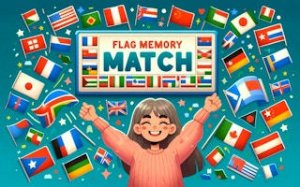
Each tile on the board shows a national flag. On every turn, you flip two cards. If they depict the same flag, the pair stays face-up. If not, both cards flip back over. The round ends when every pair has been matched. Because mismatched cards are hidden again, you need to remember not just where a flag was, but also its colors, symbols, and layout. That dual recall—position and design—is the core challenge.
Learning Geography by Playing
The flags come from a wide selection of countries. There is no quiz or label; you learn by seeing the same flag repeatedly and matching it. Over multiple sessions, you start to recognize patterns like Nordic crosses, pan-African colors, or distinctive emblems. This turns passive memorization into an active process. The game does not test you on country names directly, but the visual familiarity you build can make later geography study easier.
Adjustable Challenge for Different Ages
Early rounds use a smaller grid with fewer flags, so younger players or newcomers can get used to the rules. As your recall improves, the board expands and adds more pairs. The difficulty curve is gradual, which keeps the game accessible for children while still offering a satisfying mental workout for adults. Accuracy matters more than speed, so there is no pressure to rush. This makes it suitable for quiet play at home or in a classroom.
Visual and Accessibility Choices
The interface is clean and uncluttered. Flags are rendered in clear, vibrant colors, and cards are large enough to see details on smaller screens. The design avoids distracting animations or loud sounds, which helps in shared or educational settings. The description notes that colorblind-friendly patterns may be included, so recognition can rely on shape and layout rather than color alone. That attention to accessibility broadens who can play.





Editorial Notes