Digit Connect Math Challenge
Reviews
Digit Connect Math Challenge is a straightforward grid puzzle built on a single clear rule: connect neighboring digits so their sum matches the target. The difficulty ramps from small boards to larger, denser grids, which keeps the mechanic fresh without adding unnecessary systems. Its minimal interface and tap-to-connect controls make it easy to pick up, and the optional hints support players who get stuck. Best suited to puzzle fans and anyone wanting low-pressure arithmetic practice.
Description
Building a Path to the Target
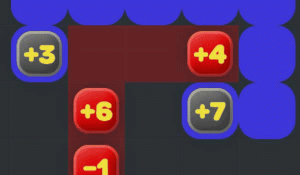
Each puzzle presents a grid of digits and a single target number. The player's job is to trace a path through neighboring cells, moving only horizontally or vertically, so the digits along that path add up to the target. Every digit can be used once per puzzle, which turns a simple addition exercise into a route-planning problem. The restriction matters because it prevents brute-force guessing: once a cell is committed to the path, it is no longer available for a different combination.
How the Challenge Grows
Early boards are small and the targets are low, so players can solve them by scanning adjacent pairs or short chains. Later levels use larger grids, higher target numbers, and denser number placements. That shift changes the nature of the puzzle. On a small board, the path is usually visible at a glance. On a larger board, players have to plan several moves ahead and consider which cells to reserve for later steps. Each completed level unlocks the next, giving the difficulty curve a clear structure.
Controls and Visual Feedback
The interface keeps distractions to a minimum. Digits appear in a clear font on a neutral background, and each cell is well-defined so available numbers are easy to read. When a path is drawn, the selected cells highlight immediately, confirming which digits are part of the current sum. Controls are limited to tapping or clicking to connect numbers, so the focus stays on the puzzle rather than on learning a complex input scheme.
Hints and Independent Solving
Optional hints are available when a puzzle stalls. These hints are designed to be subtle: they might highlight a possible starting point or suggest one number to include, rather than revealing the full solution. Players who prefer to solve independently can ignore them entirely. The result is a puzzle game that supports both self-reliant solving and a gentle safety net for harder boards.




Editorial Notes