Bounce Through Barriers
Reviews
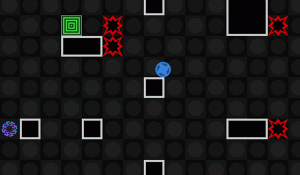
Bounce Through Barriers earns its challenge from a single mechanic: tap to jump a rolling ball through a wall's only gap. There is no steering or speed control, so every failure points back to timing. Early levels are forgiving, then openings narrow and walls arrive faster, occasionally shifting or changing speed. Short levels and instant restarts suit brief sessions, while the gradual curve rewards persistence. The clean visuals and audio cues support quick reading of each wall. Best for players who enjoy reflex-driven puzzles in small doses.
Description
A Single Tap, A Single Gap
Bounce Through Barriers reduces its entire control scheme to one input: a screen tap that makes the ball jump. The ball never stops rolling forward. Each wall that appears has one opening, and clearing it depends on releasing the tap at the right moment. Tap early or late and the ball meets the wall, ending the attempt. Because there is no steering, no secondary button, and no way to slow the ball down, every failure traces back to timing rather than positioning. That constraint is what makes each wall feel like a compact puzzle instead of an obstacle.
How Difficulty Escalates
Early walls arrive slowly and leave wide gaps, giving new players room to learn the jump arc. Later arrangements tighten the openings, speed up the approach, and vary the patterns. Consecutive walls can demand that you plan two or three jumps in advance rather than reacting to one gap at a time. Some walls shift position or change speed, which removes the comfort of a fixed rhythm. The curve stays gradual, so the game remains approachable while still asking more of your reflexes at each stage.
Reading Walls Before You Jump
Success depends on scanning the upcoming wall while the ball is still traveling toward it. The clean visuals keep the ball and the gap easy to track, and the audio cues confirm whether a jump connected or clipped the wall. Those cues matter during repeated attempts: they tell you whether you jumped too early, too late, or at the right frame. Restarts are quick, so a failed attempt costs little and the next try begins almost immediately.
Built for Short Sessions
Most levels finish in under a minute, which suits quick breaks and repeated retries. The one-button design means no tutorial is needed; the first wall teaches the mechanic. Longer sessions work too, since difficulty climbs steadily across levels. Bright backgrounds and smooth animation keep attention on the ball without visual noise, and the overall presentation stays family-friendly.




Editorial Notes